Testing is the Bottleneck
Marie Mayer, Ph.D.
Fifteen years of testing batteries has taught me that it’s a giant pain in the ass, but I keep coming back for more because it’s the driving force behind making the right product. Electrochemical testing is slow, uses expensive channels, requires safety management at scale, and data streams rely on a programming mastermind.
Therefore, battery testing is 100% the bottleneck in shipping a functional product in the most effective (profitable) companies. Worse, we need the results from battery testing, but, unlike buying manufacturing equipment or parts, testing spend is fundamentally overhead. Therefore, the proper way to design a company test program is to maximize “learning efficiency”:
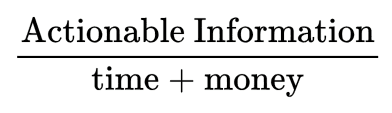
For those of you chemists annoyed right now because my units don't cancel, well, now I have your attention: actionable information saves money, and of course…
Time is Money
Wasting time to get results just costs money:
Missed timelines mean lost customers or widening competitive gap.
Waiting on information causes delays or at-risk spending by the rest of the company
There are basically 5 ways we spend money on testing:
Hardware - those damn channels add up, plus fixturing and consumables
Materials - fully tested assets are just high cost scrap
Data storage - servers, cloud space, security
Software - data processing programs like JMP or third party tools.
Humans - hands to build/run/teardown and brains to design/interpret tests
Assuming you’re doing the right tests to understand, design and validate your product (a real risk at any pace of innovation), getting information sooner yields profit sooner. Unfortunately, upfront investment in hardware, materials, operations staff or data systems is mostly a brute-force tradeoff tied to a company’s cash and production. These additional tests provide little economy of scale—they simply allow more tests to run sooner at higher total cost.
Therefore, the most effective way to increase the ratio above is:
Ensure human brains are primarily making decisions from reason and drive actions.
Improve operational behaviors & invest in software to ensure all hardware approaches 100% utilization
More Humans
Human brain optimization is a catch phrase of 2026 that I won’t re-litigate here… won’t AI just find all the trends and tell us what the problems are? 🦄 To implement corporate solutions effectively, you need a professional to orchestrate their implementation and synergy, actually simplifying the system for the rest of the engineers.
More Efficient Operations
Operational habits are how we maximize actionable information given a fixed spend on hardware, materials and data storage. Per Goldratt's Theory of Constraints, we must keep channels running at near 100% capacity. This means lean manufacturing principles like andon (notifications) or kaizen (continuous improvement) and test sample buffers in front of tools. It means quality control to ensure stable platforms and pre-validated, clearly identifiable recipes.
Speaking as a Ph.D. who’s converted to a manufacturing enthusiast, I’m confident that few individuals are trained in both testing and operations expertise. Most test departments end up reinventing one or another.
The Solution
I want to be clear that the content here is all my own, but certainly it’s not purely coincidence that I’ve been asked to write a guest post for Ohmic Labs! What I’ve seen at Ohmic Labs is two-fold:
The founders have lived these problems first-hand and been the actual (successful) problem solvers.
The flexible-yet-scalable solution they have produced is elegant. It attacks learning efficiency on both fronts - human efficiency and operational gaps.
They’ve written software that guides the user through known testing complexities using strong operational principles. You don’t need to trust, but can see that your hardware is all working for you with >90% utilization, you can know that tests won’t destroy your assets and can end errors and time wasting of manual entry.
With the distraction of reinventing best practices, your team can focus on developing your actual, salable product, and the software actually teaches them good practices that these experts have learned through experience.
It’s normal for testing to be the bottleneck in a successful product development company: this is the reason to invest in optimization and best practices to simplify, be faster and more confident in results. Ohmic Labs has actually designed a product to help you get ahead.
Check out more of our articles:
Ready to take your battery lab to the next level?
At Ohmic Labs we believe we can help you learn faster for less. Book a call with us today to level-up your battery test operations.