Donut Lab Fast Charge Test #1: Testing Strategies and Raw Data
Michael Plews
What the Donut Lab Fast-Charge Test Actually Shows (And What It Doesn't)
This week, Donut Lab published independent fast-charge test results for their solid-state battery, conducted by VTT Technical Research Centre of Finland. At Ohmic, we spend a lot of time thinking about how battery tests are designed and what the data actually says — so we took a close look at the report.
The Comparison That Caught Our Attention
The most interesting detail in this report isn't the fast-charge headline number. It's how Donut Lab's test protocol compares to other published fast-charge data in the industry. SES (2021), QuantumScape (2022) (+reference cycle), and Donut Lab all tested fast charging — and all three used meaningfully different conditions:
Company | Fast charge voltage cutoff - capacity check voltage cutoff (V) | End of fast charge condition |
SES | 0 | Reference capacity met |
QuantumScape | 0 | Cut current |
Donut Labs | +0.15 | Reference capacity met |
None of these approaches are wrong, but they're not directly comparable either. When protocols differ across organizations — different voltage windows, different end conditions — each can be accounted for in their future BMS systems, but the numbers can't be evaluated side by side at face value.
The Test Itself
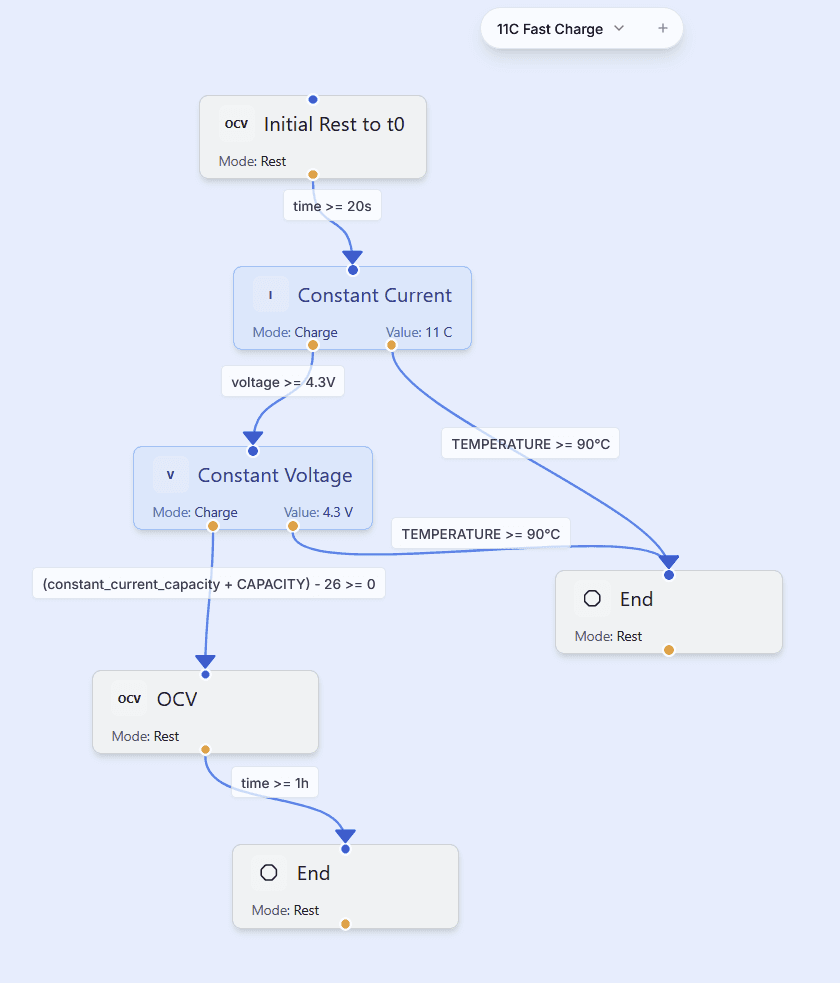
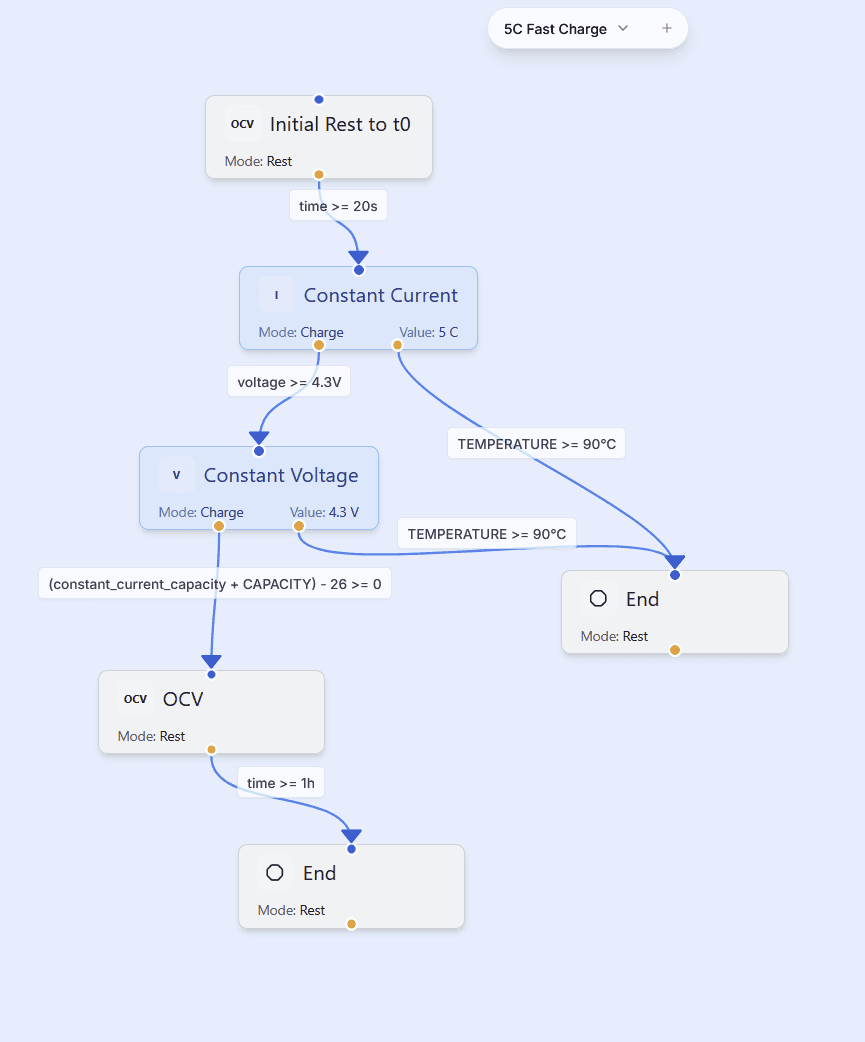
VTT ran three main protocols on a single 26 Ah cell: a standard 1C-1C capacity check, a 5C fast charge, and an 11C fast charge. The capacity check establishes a baseline — you need it to know how much capacity the cell actually has before and after you push it hard.
The capacity check used a 4.15V ceiling and 2.7V floor, with charging ending when the current tapered to C/20 — a standard CCCV approach. The fast charge protocols bumped the voltage ceiling to 4.3V to overcome the higher impedance seen at aggressive charge rates.
One detail worth calling out: VTT used a "discharge first" approach, meaning they ran an initial charge, then started counting cycles from the first discharge. This is clearly noted in their report, but it explains why the data visually shows two full cycles while only one "Charge Capacity" figure is reported. It's a methodological choice, not a mistake.
We made each of the Donut Lab protocols in Ohmic Labs to illustrate below:

What the Raw Data Tells Us
VTT's report was generated with matplotlib and exported as a vector PDF, which means the underlying data points are still mathematically encoded in the file. Extracting those points directly, the calculated capacity values match VTT's reported figures to within ~0.007% — a good confirmation that the extraction is clean.
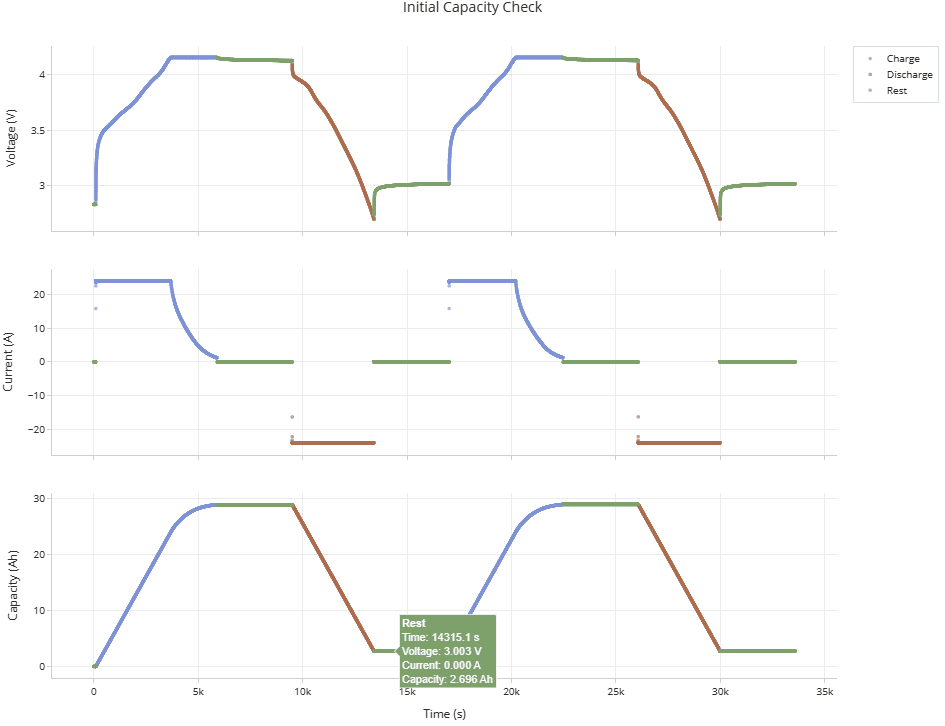
Two things stand out. First, there's roughly 10% irreversible capacity loss after the initial charge-discharge cycle. This is normal for lithium-ion chemistry and suggests the cell saw little to no pre-conditioning before arriving at VTT — otherwise that first-cycle loss would have already occurred.
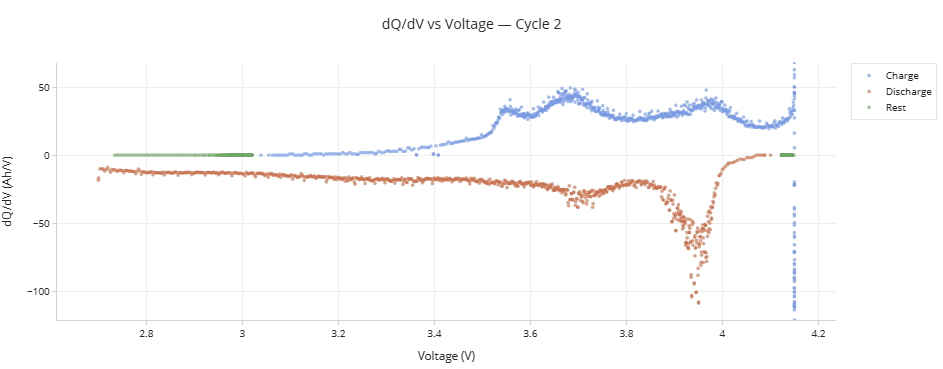
Second, plotting dQ/dV from the 1C charge cycle gives a rough fingerprint of the cathode chemistry. The peak structure is consistent with an NMC-based cathode, which aligns with the performance profile you'd expect. Worth noting: 1C is faster than ideal for this analysis and the signal is noisier than a proper low-rate dQ/dV would be. But the data we have points to NMC.
The Bigger Picture
The fast-charge result is real. An 11C charge to 80% in 4.5 minutes, independently verified by a credible institution, is a meaningful data point.
The remaining claims — 400 Wh/kg energy density, 100,000-cycle lifespan, lithium-ion cost parity — remain unverified by any third party. VTT tested one aspect of the battery's performance. More data will follow as the "I Donut Believe" campaign continues.
What this report reinforces is something fundamental to battery testing: how you test shapes what you can conclude. Consistent, well-documented protocols aren't just good practice — they're what makes cross-organization comparison possible at all. That's exactly the problem Ohmic is built to solve.
Check out more of our articles:
Ready to take your battery lab to the next level?
At Ohmic Labs we believe we can help you learn faster for less. Book a call with us today to level-up your battery test operations.